Автор: deniac
Дата: 10-02-09 11:17
Canon написа:
> danbi
> И двете не влият на ров. И двете преди записа на РОВ-а са
> излъгали меренето и реално недоекспонират, респ местят
> стойността за 18% (М) в около М-1ЕВ. Как се компенсира
> (криви-миви, опции от ЕКСИФ...) е друго.
Влияят на RAW-a. Няма голямо значение какво точно се случва, но полза има. Често я наричат тази функция "сватбарска", защото спасява детайла на булченските рокли. Вкарва повече шум в тъмните области обаче.
Ето ви цитат от ревюто на чичо ви Боб от тук:
http://www.bobatkins.com/photography/digital/canon_eos_40D_review_6.html
Well, I've now had a chance to look a little more closely at the Highlight Tone Priority mode, and my guess about RAW files (see above) turns out to be wrong. It appears that Highlight Tone Priority affects both the RAW file and the JPEG file. I'm not quite sure what Canon are doing, but it appears to be more than just different processing of the RAW file into a JPEG. It may be some hardware related feature but until Canon tell us, it's hard to say just what's going on. Looking closely at images shot with Highlight Tone Priority turned on and off, there is an increase in the shadow noise if you look closely enough. However in situations which need highlight tone preservation, the increased detail in the highlights far more than makes up for any slight noise increase in the shadows.
In the first set of images below there are a series of crops from the image of a step transmission target at the "highlight" end of the range. These were taken from RAW images shot at ISO 200, "developed" with a -2 exposure compensation in DPP 3.1 to better show the range of highlight detail. It's quite clear that with Highlight Priority on a greater range of densities is recorded (higher light levels still record as shades of gray rather than pure white), which translates to better highlight detail. The numbers in the top left corner of each patch are the average luminosity values.

http://www.bobatkins.com/photography/digital/40D/hp1a.jpg
In the second sets of images shown below we are looking at the other end of the target, the high density patches which correspond to deep shadow detail. The upper row shows these patches cropped from an ISO 200 shot RAW file "developed" with +2 exposure compensation to bring out shadow detail. As you can see the density range of both patches is similar which shows that using highlight priority hasn't lost and shadow detail. Note that you can't directly compare densities with the previous image as these were developed from the RAW files with a +4 stop relative exposure adjustment.
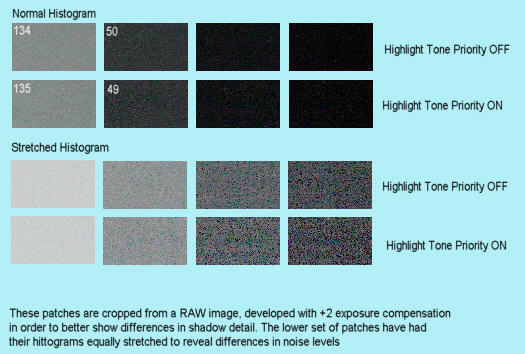
http://www.bobatkins.com/photography/digital/40D/hp2.jpg
The lower 2 rows of patches in the figure above show the same images as the upper 2 rows, but with large changes made to the contrast and tonal range via histogram adjustments in order to show the noise. I think you can see that using highlight priority has boosted the noise slightly, though this noise probably wouldn't be seen in a normal print.
How much expansion of highlight range do you get? I'd say around 1 stop. My transmission targets are not precisely calibrated, but it looks like you can get away with about 1 stop more exposure without blowing out the highlights when Highlight Tone Preservation mode is switched on.
One way Canon might be doing HTP is to use some sort of amplifier with non-linear gain. Let's say you set the camera to ISO 200 with HTP on. You could then apply the gain of the ISO 100 setting (which may be a gain of 1) to the highlights (pixels with high values), but the gain of the ISO 200 setting to the shadows (pixels with low values). That would keep the highlights from blowing out while retaining shadow detail. You'd get the highlight detail of shooting with an effective -1 EC for the highlights, and the normal shadow detail for ISO 200 (no EC). It's possible you might then have to tweak the tone curve a bit for the best looking image.. This is just a guess of course, made on the basis of some forum and email discussions. It would explain why you can't use HTP at ISO 100 (if the "native ISO" of the sensor is 100, then there may be no gain applied at ISO 100, so you can't then apply less gain with HTP turned on!)
[• end of 09/28/07 update]
|
|



![[smilie3]](https://photo-forum.net/forum/smileys/smilie3.gif)
![[smilie18]](https://photo-forum.net/forum/smileys/smiley18.gif)
![[smilie5]](https://photo-forum.net/forum/smileys/smilie5.gif)
![[smilie6]](https://photo-forum.net/forum/smileys/smilie6.gif)
![[smilie7]](https://photo-forum.net/forum/smileys/smilie7.gif)
![[smilie21]](https://photo-forum.net/forum/smileys/smiley21.gif)
![[beer]](https://photo-forum.net/forum/smileys/smiley20.gif)
![[shtrak]](https://photo-forum.net/forum/smileys/shtrak.gif)
![[smilie8]](https://photo-forum.net/forum/smileys/smilie8.gif)


 Стани фен на Фото Форум във Facebook
 Фото Форум в Instagram